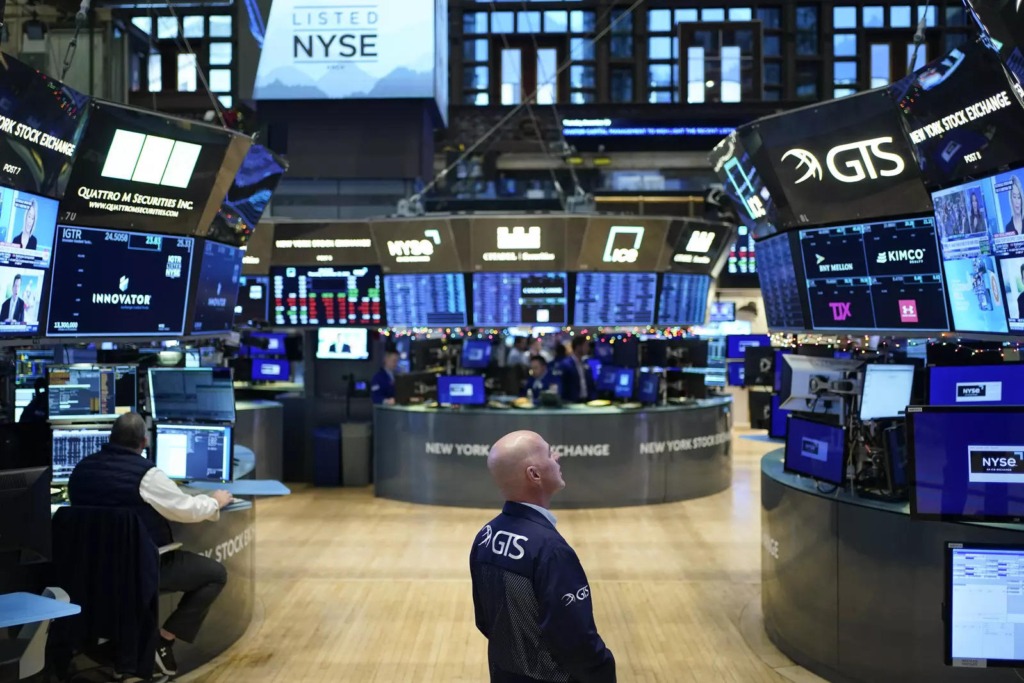
Asian equities traded mostly higher, US equity futures rebounded and oil prices dropped as renewed diplomatic efforts raised hopes of reopening the Strait of Hormuz. Behind the rebound, however, investors continue to question how much the largest technology companies are spending on artificial intelligence and the returns that spending is likely to generate. This week brings the US midterm elections, the October jobs report and earnings from Apple, AMD, Qualcomm and Palantir.
Global equity markets
Equity performance varied by region, with technology shares at the centre of the moves in the US and Europe.
Asian markets start the week higher
South Korea led the region, with the KOSPI rising 2.6% as SK Hynix and Samsung Electronics moved higher. In mainland China, the CSI 300 gained 1.3% and the Shanghai Composite added 1.2%, while Hong Kong’s Hang Seng rose 0.6%. Japan’s Nikkei was up 0.4%. Not every market joined the advance, as Australia’s ASX 200 slipped 0.5% and Singapore’s STI lost 1.4%.
US futures recover after a weak October for technology
By 05:50 CET, Nasdaq 100 futures were up 1.0%, S&P 500 futures had gained 0.5% and Dow Jones futures were 0.4% higher. Technology names drove the recovery, which points to investors returning to the sector after last week’s steep decline and reassessing valuations and seeking opportunities following the recent weakness.
The Nasdaq dropped 2.9% on Friday after disappointing results from Amazon and Intel added to worries about AI spending and technology valuations. The index lost more than 5% in October, its weakest month since March 2025. The Dow, by contrast, rose by close to 2% over the month, reflecting stronger performance from smaller companies and value stocks. This gap between the two indices shows a growing rotation away from highly valued technology shares as investors look more closely at the cost of AI investment and the returns it is likely to generate.
European equities remain resilient over the month
European shares also closed Friday in negative territory, with technology again the weakest area. ASML, Infineon and STMicroelectronics all fell sharply and NatWest lost ground, while AstraZeneca rose by more than 7% and cushioned the decline. Even after Friday’s losses, the Stoxx 600 finished the week 2.1% higher and gained 1.9% across October, a sign that the wider European market has held up relatively well.
Bonds, currencies and commodities
Safe-haven demand, the upcoming US midterm elections and diplomatic efforts around the Strait of Hormuz shaped moves across fixed income, currencies and oil.
US Treasury yields stay close to seven-week lows
Government bonds continued to find support, with the US 10-year Treasury yield at 4.93%, close to its lowest level in seven weeks. Demand for safer assets helped offset stronger US data, including third-quarter GDP growth and higher inflation. Markets are still weighing the possibility that the Federal Reserve raises interest rates in December, so the rate outlook remains unclear.
Dollar edges up while the euro stays near a 17-month low
The dollar index rose 0.1% to 101.94 as investors waited for the US midterm elections and a series of important economic releases. The euro gained 0.1% to 1.1169 against the dollar but remained close to its lowest level in 17 months, held back by worries over France’s deteriorating public finances.
Oil falls on hopes for the Strait of Hormuz
Oil prices dropped by more than 3%, taking Brent to around $110 a barrel and WTI to $101. Renewed diplomatic efforts have raised expectations that the Strait of Hormuz could reopen and that supply disruptions could ease, although geopolitical risk remains high. OPEC+ left its December production targets unchanged and pushed any further policy changes into next year.
Economic developments
New data from China and a ratings decision on France added to the macroeconomic picture.
China’s PMIs show uneven conditions
Chinese economic activity weakened in October. The official manufacturing PMI fell to 49.3, while the services and composite PMIs both came in at 49.7, placing all three in contraction territory. The private manufacturing PMI told a different story, holding in expansion at 52.0 on the back of stronger factory output and higher domestic and export orders. The divergence suggests that conditions remain uneven between larger state-linked manufacturers and smaller private businesses.
Fitch moves France’s outlook to negative
Fitch changed its outlook on France’s credit rating from stable to negative, pointing to deteriorating public finances, slower growth and political fragmentation. The agency expects French public debt to reach 124% of GDP by 2028. The decision raises the risk of a downgrade later on and adds to existing concerns about the country’s fiscal position.
Corporate news and investment implications
Concerns over the cost and returns of AI investment continued to weigh heavily on technology shares.
Technology
- Intel: Shares plunged approximately 29% on Friday after the company forecast quarterly revenue more than $1bn below expectations and warned of negative cash flow this year. Despite 80% growth in data-centre revenue, weak PC demand, higher memory costs and heavy investment continue to weigh on performance, and losses spread across semiconductor and hardware shares.
- Meta: S&P Global revised its credit outlook to negative from stable, citing escalating AI investment, uncertain returns and deteriorating cash flow. Meta plans capital expenditure of up to $145bn this year, reinforcing concerns that even the largest technology companies may face pressure to show their AI spending can generate sufficient returns.
- SanDisk: Shares fell more than 11% on concerns that NAND memory price growth is slowing, overshadowing a 378% year-on-year rise in revenue to $11.03bn.
- Apple and Nvidia: Apple overtook Nvidia as the world’s most valuable listed company, at $5.03trn against $4.93trn. Deutsche Bank upgraded global technology shares to Overweight on improved valuations and resilient earnings, while Goldman Sachs warned that higher interest rates and AI-related disruption could weaken household equity demand.
- DeepSeek: Unveiled Super-Agent, an open-source AI coding agent that identifies software development issues and proposes solutions with minimal human input, intensifying competition with US AI developers, particularly Anthropic’s Claude Code.
- Capgemini: Raised its 2026 revenue growth forecast for the second time this year after third-quarter revenue rose 12% to €6.07bn, supported by demand for AI-related services.
Other sectors
- China’s state-owned banks: Shares in the major lenders rose after they reported their fastest quarterly profit growth in several years, with third-quarter profits up 10% at ICBC, 10.8% at Agricultural Bank of China and 9.8% at China Construction Bank.
- Pharmaceuticals: AbbVie’s third-quarter revenue rose 10.3% to $17.4bn and the company raised its earnings guidance and increased its dividend by 5.2%. Sanofi raised its full-year sales and earnings forecasts, and Merck delivered a solid performance. US drug-pricing negotiations remain a longer-term risk, expected to become more significant in 2027.
- Energy: ExxonMobil and Chevron exceeded third-quarter earnings expectations on higher refining margins. BP reported a record quarterly underlying profit of $8.46bn and cut net debt to $13.9bn, reaching its target a year early.
- Evonik and Volkswagen: Evonik rejected BASF’s takeover approach despite a revised valuation exceeding €11bn. Volkswagen has suspended preliminary development work on its electric Golf amid financial pressures, though the model’s planned launch is reportedly unaffected.
What to watch this week
Today’s economic data
Monday’s agenda features the Manufacturing PMI and the US ISM Manufacturing PMI, both key gauges of industrial activity and the wider economy. After the weaker official PMI readings from China, investors will look for further evidence of how manufacturing is holding up.
US midterm elections and the October jobs report
Tuesday’s US midterm elections and Friday’s October employment report will dominate the week. Investors will watch the election results for possible effects on AI regulation and corporate policy more generally. The jobs report will give an important update on the US labour market and could shift expectations for Federal Reserve policy.
Earnings, central banks and geopolitics
Apple, AMD, Qualcomm and Palantir lead the week’s technology earnings, alongside McDonald’s, Amgen and ConocoPhillips. The focus will be on returns from AI investment, capital expenditure plans and how well earnings are holding up after the recent technology-led correction. Markets will also follow economic data from China and the eurozone, eurozone inflation, several central bank decisions, including those of the Bank of England and the Reserve Bank of Australia, geopolitical developments and the OPEC meeting.
This information is being provided solely for information purposes and should not be deemed or construed as investment advice, tax, legal, or any other ancillary regulatory advice. CCIS does not accept liability for actions, proceedings, costs, demands, expenses, damages, and losses suffered by persons as a result of information, views, or opinions appearing in this document. The financial instruments discussed are intended for retail clients however, they may not be suitable for all investors and investors must make their own informed decisions and seek their own advice regarding the appropriateness of investing in financial instruments or implementing strategies discussed herein. The value of the investment may go down as well as up and may be affected by changes in currency. Where investments are denominated in a currency other than the investor’s base or reporting currency, changes in foreign exchange rates may adversely affect the value and/or returns of the investment. Any performance figures quoted refer to the past and past performance is not a guarantee nor a reliable guide to future performance. Calamatta Cuschieri Investment Services Ltd (C13729) is licensed by the MFSA to carry out investment services business in terms of the Investment Services Act (Cap. 370). The company is a subsidiary of Calamatta Cuschieri Moneybase plc and is registered at Level 0, Ewropa Business Centre, Dun Karm Street, Birkirkara BKR 9034, Malta.