Wall Street broadens beyond technology
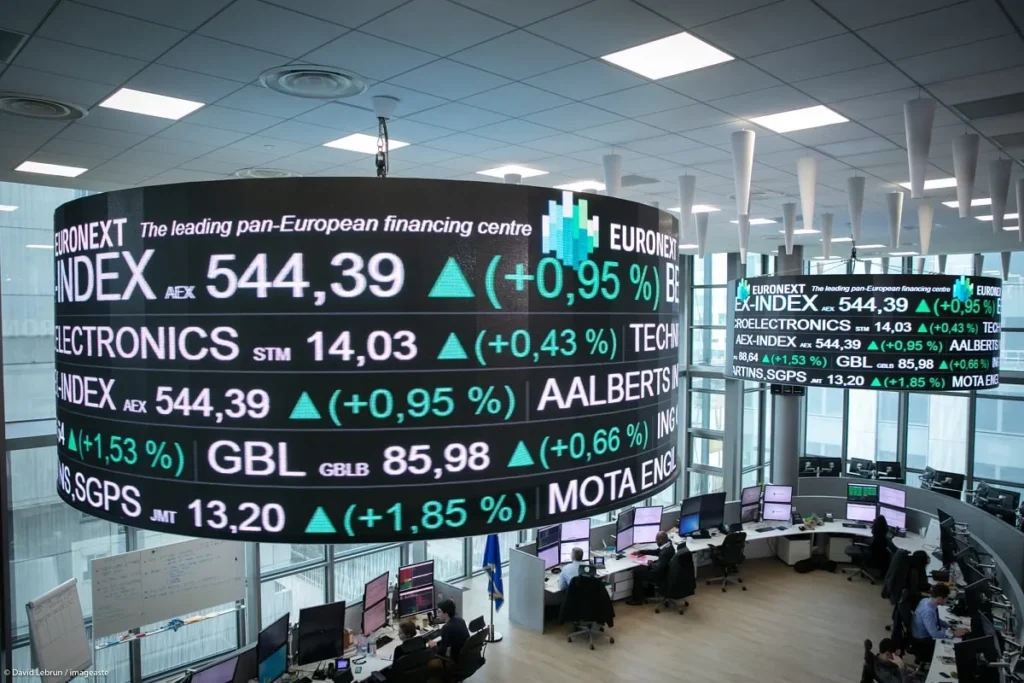
US equities managed to finish Tuesday’s session higher even as chipmakers came under renewed pressure.
The Dow Jones Industrial Average rose 1%, moving to within 1% of its record high, while the S&P 500 also advanced as gains broadened across healthcare, consumer staples, financials and industrials. The strength in defensive and cyclical sectors helped offset a 4.5% decline in semiconductor shares, with the sector’s benchmark index falling into bear market territory.
Treasury yields eased alongside the equity rotation, with the 10 year US yield slipping to around 4.60%. The dollar softened modestly, and West Texas Intermediate crude dipped below $80 a barrel on optimism surrounding US-Iran peace talks.
Strong corporate earnings have continued to underpin the advance. Around 85% of S&P 500 constituents that have reported second quarter results so far have beaten analyst expectations, a beat rate that reinforces a broadly constructive picture for diversified equity portfolios.
Investor attention now turns to a pivotal week for markets, with earnings from Microsoft and Meta due today, followed by Amazon and Apple tomorrow. Markets will be closely watching not only earnings results but also updates on AI-related capital expenditure, as investors increasingly demand evidence that elevated spending is translating into stronger profits. The Federal Reserve is widely expected to leave interest rates unchanged this week, although policymakers are likely to retain a hawkish tone given persistent inflation risks, leaving the door open for a potential rate increase later this year.
Asian markets extend their technology led selloff
Asian equity markets fell sharply on Wednesday, led by South Korea and Japan, as the technology sell-off deepened amid concerns over AI valuations and semiconductor competition.
South Korea’s KOSPI suffered another heavy decline, while losses spread across Taiwan, Hong Kong and mainland China ahead of key US earnings and the Federal Reserve’s policy decision.
US equity futures traded modestly lower in the hours ahead of Wednesday’s Wall Street open, weighed down by renewed Middle East tensions and persistent weakness in technology shares, with markets closely focused on AI spending, interest-rate guidance and the outlook from the major technology companies, heading into the Federal Reserve’s policy announcement and the Microsoft and Meta earnings due later in the day.
European equities find support in earnings strength
Corporate results lift the STOXX 600
European shares edged higher on Tuesday, supported by a run of solid corporate earnings and softer energy prices. The STOXX Europe 600 rose 0.4%, with consumer goods group Unilever, carmaker Mercedes-Benz, aerospace group Safran and telecoms operator Orange among the session’s notable gainers following upbeat updates.
Technology remains the regional laggard
Technology stocks bucked the broader European advance, with chip equipment maker ASML falling further as concerns persisted over the durability of AI related capital spending and rising competition from Chinese semiconductor manufacturers.
Currencies and commodities react to shifting risk sentiment
Dollar holds steady as Fed decision looms
The US dollar held broadly steady around the 101.3 level as investors awaited the Federal Reserve’s policy announcement, with markets continuing to price in a meaningful probability of future interest rate increases. Renewed tensions in the Middle East and firmer oil prices added a further layer of support for the currency’s safe haven appeal. EUR/USD traded near 1.1403 as eurozone investors positioned for the Fed’s next move.
Oil rebounds sharply on renewed Iran tensions
Oil prices rebounded by more than 4% after Iran launched a fresh wave of missiles targeting US forces in the region, reviving supply concerns following several days of relative calm. The move higher was reinforced by a larger than expected drawdown in US crude inventories and reports that OPEC+ may pause planned production increases scheduled for October.
Stocks in focus this week
Technology and AI infrastructure
SK Hynix posted record second-quarter earnings as strong demand for AI memory chips drove sharp increases in revenue and profit, though shares fell as results missed elevated market expectations and investors remained cautious over AI spending, with management maintaining a positive outlook on high bandwidth memory and AI infrastructure demand.
Amazon is scaling back several in house Nova AI models in favour of a new frontier model as it shifts resources towards advanced AI research to compete more directly with OpenAI, Anthropic and Google, while continuing to prioritise AI infrastructure investment through AWS.
Meta chief executive Mark Zuckerberg argued publicly against US restrictions on Chinese AI models, saying such measures would not be an effective strategy to maintain leadership in the global AI race, and warned that excessive regulatory influence, or “regulatory capture,” by leading American AI firms could reduce competition, limit innovation and slow technological progress.
KLA Corporation shares fell 10% after weaker than expected forward guidance overshadowed an earnings and revenue beat, with the company forecasting first-quarter earnings and fiscal 2027 revenue within a broad range but below some market expectations, raising concerns over the outlook for future growth.
Seagate Technology rose more than 8% after hours on stronger than expected quarterly revenue and profit guidance tied to rising demand for high capacity hard drives used in AI infrastructure, with fourth-quarter revenue also beating expectations as cloud providers expanded storage capacity to support generative AI applications.
Industrials, autos and travel
Rio Tinto shares rose close to 5% this morning after first half earnings beat expectations, increased its interim dividend and highlighted robust demand for copper and other metals linked to AI infrastructure; net profit increased 47% to $6.66 billion, supported by higher commodity prices, improved production and productivity gains.
Boeing reported a larger than expected second quarter loss but beat on revenue, with commercial aircraft deliveries increasing and production stabilising; the company returned to positive free cash flow and lifted its record order backlog to $715 billion, sending shares nearly 3% higher.
Ford raised its full year earnings guidance for the second time on resilient demand, pricing strength and improved operational efficiency, with second-quarter adjusted earnings beating expectations despite tariff costs and EV losses; shares rose after hours as investors welcomed the stronger outlook and progress in improving the company’s core business.
Royal Caribbean lifted its annual profit forecast after beating quarterly expectations, sending shares higher, supported by strong demand from higher income travellers, pricing power and onboard spending, despite some cruise disruption linked to Middle East tensions; the company lowered revenue growth guidance slightly but increased its annual adjusted earnings expectations.
Payments, consumer and financials
Visa’s payment volumes exceeded $4 trillion for the first time, supported by resilient consumer spending and World Cup-related travel, with cross-border transactions remaining strong; shares slipped after hours despite the earnings beat, as the company also announced workforce reductions to improve efficiency.
PayPal beat second-quarter earnings and revenue forecasts, prompting it to raise its full year profit guidance above market expectations, with strong payment volumes supporting results although higher operating costs weighed on margins; shares rose more than 2% on continued takeover speculation.
Coca-Cola lifted its full year profit outlook after stronger than expected second-quarter results, driven by robust sales and World Cup related demand, with revenue rising 7% to $13.4 billion and earnings per share beating forecasts at $0.97; improved margins and stronger organic revenue guidance sent shares up more than 6%, despite a challenging consumer environment.
UPS beat expectations in the second quarter, with revenue rising 7.7% and upgraded its full-year guidance, supported by higher pricing and improved domestic and international performance following the Amazon volume reduction, yet shares fell over 5% on execution and margin concerns.
Barclays reported a 17% rise in first half profit, beating expectations on strong equities trading and investment banking fees, and raised its income guidance alongside a larger than expected £1 billion buyback, though shares fell over 4% as investors judged the investment banking strength to already be priced in.
European corporates
Unilever raised its full year sales outlook after second-quarter underlying growth of 5.8% beat expectations, driven by strong volume growth across key brands, sending shares up more than 6%; Home Care, Beauty and Personal Care performed strongly while Foods lagged. The company expects continued growth and modest margin improvement despite commodity cost pressures.
GSK reported stronger than expected second-quarter results, driven by growth in Specialty Medicines and Vaccines, and reaffirmed its full-year outlook while launching a £1.9 billion cost saving programme to fund pipeline investment and protect margins; shares rose more than 5% as GSK highlighted increased clinical trials and promising oncology developments.
EssilorLuxottica posted solid first half growth, with revenue rising 9.7% at constant exchange rates and adjusted operating profit increasing 15%, supported by strong direct-to-consumer performance, higher demand for myopia management lenses and rapid expansion in AI-enabled eyewear, with margins and free cash flow also improving.
Kering’s Gucci brand reported a smaller than expected second-quarter sales decline, supported by stronger US demand and improved handbag sales; revenue fell 4% but marked an improvement from the previous quarter, with shares rising as investors saw signs that CEO Luca De Meo’s turnaround strategy is beginning to gain traction.
Analyst and broker commentary
Franklin Templeton has argued that the current AI led rally differs meaningfully from the late 1990s internet boom, pointing to the profitability, cash generation and competitive positioning of today’s leading technology companies as evidence the cycle is maturing rather than fading; the firm believes heavy infrastructure investment creates higher barriers to entry, with investors increasingly favouring AI infrastructure suppliers.
HSBC believes the recent broad based selloff in risk assets has run its course, with its sentiment indicators turning positive again; despite geopolitical shocks, equities have remained resilient, supported by improving earnings expectations, lower valuations and investor positioning, and the bank remains overweight equities, high yield credit and emerging market credit, while staying underweight bonds and oil.
Upcoming economic events and earnings calendar
Wednesday’s calendar is dominated by the Federal Reserve’s interest rate decision and press conference, alongside US mortgage applications data and weekly EIA oil inventory figures.
On the earnings front, Microsoft, Meta, SK Hynix and Lam Research headline a busy day that also includes results from Procter & Gamble, L’Oréal, Hermès, Airbus and Amphenol.
This information is being provided solely for information purposes and should not be deemed or construed as investment advice, tax, legal, or any other ancillary regulatory advice. CCIS does not accept liability for actions, proceedings, costs, demands, expenses, damages, and losses suffered by persons as a result of information, views, or opinions appearing in this document. The financial instruments discussed are intended for retail clients however, they may not be suitable for all investors and investors must make their own informed decisions and seek their own advice regarding the appropriateness of investing in financial instruments or implementing strategies discussed herein. The value of the investment may go down as well as up and may be affected by changes in currency. Where investments are denominated in a currency other than the investor’s base or reporting currency, changes in foreign exchange rates may adversely affect the value and/or returns of the investment. Any performance figures quoted refer to the past and past performance is not a guarantee nor a reliable guide to future performance. Calamatta Cuschieri Investment Services Ltd (C13729) is licensed by the MFSA to carry out investment services business in terms of the Investment Services Act (Cap. 370). The company is a subsidiary of Calamatta Cuschieri Moneybase plc and is registered at Level 0, Ewropa Business Centre, Dun Karm Street, Birkirkara BKR 9034, Malta.