Oil prices surge to four-year high as fed signals caution

Global financial markets showed a cautious tone as investors assessed the latest Federal Reserve decision, major technology earnings, and a sharp rise in oil prices driven by geopolitical tensions. Economic data remained supportive, but uncertainty around inflation, interest rates, and global risks continued to influence sentiment.
US market performance and federal reserve outlook
US equity markets finished mostly lower on Wednesday, with the Dow Jones Industrial Average falling 337 points (0.69%), while the S&P 500 slipped 12 points (0.17%) and the Nasdaq Composite declined 34 points (0.14%). Most sectors closed flat to weaker, with materials and healthcare among the biggest laggards, while energy outperformed amid a sharp rise in oil prices.
Bond yields moved higher, reflecting a cautious outlook on inflation and interest rates, while global markets were mixed, with gains in Asia but softer closes in Europe.
The Federal Reserve held rates at 3.5%–3.75% for a third consecutive meeting, as expected. However, the decision revealed unusual dissent, with one governor voting for a rate cut and three opposing the policy wording, marking the largest split since 1992. The Fed signalled a data-dependent approach amid heightened uncertainty, including Middle East risks, while Chair Powell confirmed he will remain as governor.
Investors are now closely watching earnings from major technology companies, particularly around artificial intelligence-related investment, which is expected to shape near-term market direction.
Economic data released during the day was broadly positive, with durable goods orders and housing starts exceeding expectations, supporting the outlook for continued earnings growth despite concerns around inflation, elevated energy prices, and geopolitical tensions.
Global market trends
Asia markets
Asian equities mostly declined on Thursday as a surge in oil prices and cautious Federal Reserve commentary weighed on sentiment. Japan’s Nikkei and Hong Kong’s Hang Seng fell sharply, while China was broadly flat. South Korea’s KOSPI eased after hitting a record high, despite strong Samsung results. India declined, while Singapore gained and Australia edged lower.
US futures and after-hours moves
US equity futures were mixed overnight, with S&P 500 futures up 0.4% and Nasdaq 100 futures rising 0.9%, while Dow futures fell 0.3%.
In after-hours trading, Amazon and Alphabet gained on strong earnings, Meta Platforms fell sharply on weaker outlook, and Microsoft was little changed despite solid results.
Europe markets
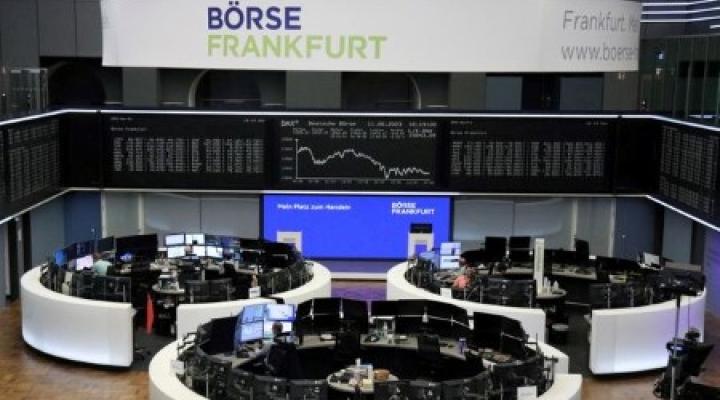
European markets fell to a three-week low, with the STOXX 600 down 0.6% and the Euro Stoxx 50 also weaker, as mixed earnings and Iran war-driven economic concerns weighed on sentiment.
Healthcare stocks led losses, with declines in GSK and AstraZeneca despite strong results. Meanwhile, Adidas rose on earnings strength, UBS gained, and Deutsche Bank fell.
Commodities, currency and economic data
The US dollar remained firm, with the dollar index holding near 99 after the Federal Reserve kept rates unchanged but struck a more hawkish tone amid inflation concerns and internal dissent. Markets have priced out 2026 cuts, supporting the dollar further. As a result, EUR/USD traded lower at 1.1660, also pressured by geopolitical tensions in the Middle East.
Oil prices surged to a four-year high, with Brent crude jumping 6.8% to $126.10 per barrel and WTI rising 3.1% to $110.24. The rally was driven by escalating US–Iran tensions, reports of possible military action, and the ongoing blockade of the Strait of Hormuz, raising fears of severe global supply disruptions.
Economic data was broadly positive, with durable goods orders and housing starts exceeding expectations.
In China, manufacturing PMI rose to 50.3, supported by strong overseas demand and rising new orders. However, non-manufacturing PMI fell to 49.4, reflecting subdued domestic demand and higher fuel costs. The composite PMI eased to 50.1, while private surveys showed stronger momentum, indicating a mixed recovery.
Equities on the move
Technology and ai driven growth
Samsung Electronics reported a record first-quarter operating profit, rising more than eight-fold year-on-year, driven by strong demand for AI-related memory chips. Growth was supported by AI servers, higher chip prices amid supply shortages, Nvidia contracts, and HBM chip demand, alongside continued capacity expansion.
Alphabet beat expectations with earnings of $5.11 per share and revenue of $109.9 billion (+22%), driven by Search and a 63% surge in Google Cloud. Margins expanded, with strong contributions from subscriptions and advertising. Shares rose over 7% after hours.
Amazon shares rose 2.7% after hours after strong results, with growth driven by a 28% increase in AWS, alongside advertising and retail strength. However, investors weighed this against sharply higher AI-related capital spending and a steep drop in free cash flow.
Microsoft forecast stronger Azure growth and announced $190 billion in 2026 capital spending. Shares were flat after volatility as investors weighed solid cloud momentum against heavy AI competition and rising costs.
Meta Platforms reported strong results but shares fell after raising capex guidance to $125–$145 billion, reflecting higher AI infrastructure and component costs, alongside concerns over returns on AI investment and modest user growth.
Industrial, energy and financial highlights
General Dynamics beat expectations, supported by strong marine and aerospace performance, improved productivity, higher jet deliveries, and supply chain recovery. Backlog and cash flow strengthened, with additional support from rising US defence spending.
TotalEnergies reported a 29% increase in profit to $5.4 billion, driven by high oil prices and strong trading linked to Middle East tensions. The company will boost shareholder returns through increased dividends and resumed share buybacks.
UBS reported $3.04 billion in net profit, with $37 billion in inflows, supported by investment banking and wealth management. Cost savings from Credit Suisse integration reached $11.5 billion, with a 14.7% CET1 ratio and continued shareholder returns.
Adidas rose over 8% after strong results, with growth led by performance categories and China. Margins declined due to tariffs and currency effects, while the company announced a €1 billion share buyback programme.
Other notable movers
Qualcomm rose over 13% after volatility, with strong Q2 results but weaker Q3 guidance. Growth in automotive and IoT, early hyperscaler chip shipments, and improving China demand supported sentiment.
KLA Corporation beat expectations but fell 7.2% due to weaker free cash flow, despite raising its dividend, expanding buybacks, and maintaining an upbeat 2026 outlook.
Porsche AG reported weaker results, with profit down 21.9% and deliveries falling nearly 15%, though margins held at 7.1% and cash flow improved.
AstraZeneca delivered strong results with revenue of $15.29 billion, supported by oncology and rare disease treatments, while maintaining full-year guidance.
L3Harris Technologies filed for an IPO of its missile solutions unit, expected to grow at mid- to high-teens rates, supported by a $1 billion US government convertible investment.
SpaceX disclosed a governance structure giving Elon Musk near-total control through super-voting shares, limiting investor influence.
Apple is planning AI-powered iPhone camera features in iOS 27, including integration with ChatGPT and visual intelligence tools.
Uber is expanding into travel by adding hotel bookings via Expedia, with plans to include Vrbo and integrate ride services into the platform.
Upcoming economic events and market focus
Key data releases include US PCE inflation, GDP, jobless claims, spending and wage costs, alongside ECB and Bank of England rate decisions and eurozone GDP and inflation data.
Earnings to watch include Samsung, Mastercard, Eli Lilly, Caterpillar, Amgen, Schneider Electric, and ConocoPhillips, with investors focused on inflation trends, growth momentum, and corporate performance across US, Europe and Asia.
This information is provided solely for educational and informational purposes and should not be construed as investment advice, advice on specific investments or investment decisions, tax advice, legal advice, or any other form of professional or regulatory advice. The information does not take into account your personal circumstances and is provided to you on the express understanding that it does not constitute advice and should not be relied upon in making any investment decision. Investing in financial instruments involves risk. You should conduct your own research before making any investment decisions and seek the assistance of a licensed financial advisor if you are unsure. No person should act on any opinion or information contained in this document without first obtaining appropriate professional advice. Calamatta Cuschieri Investment Services Limited does not accept liability for any actions, proceedings, costs, demands, expenses, damages, or losses suffered as a result of reliance on the information herein.