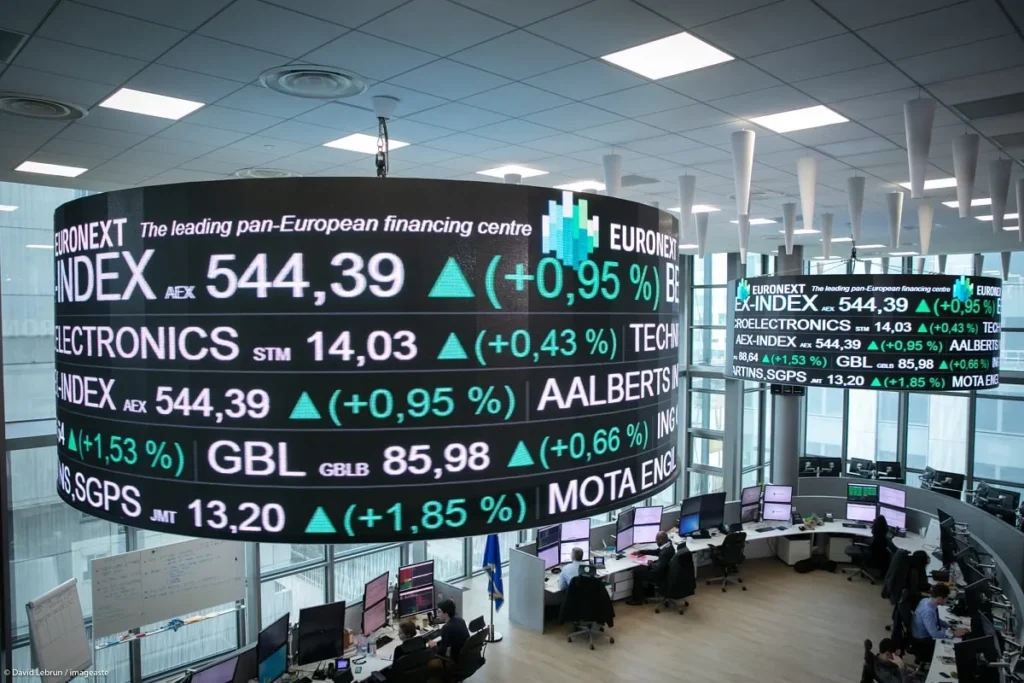
US equity markets began the week on a strong footing, driven by an unexpected breakthrough in geopolitical tensions and renewed appetite for growth assets. A landmark agreement between Washington and Tehran to reopen the Strait of Hormuz sent oil prices sharply lower, unlocking a wave of optimism that rippled across global markets. Here is a full breakdown of the key developments shaping investor sentiment this week.
US equities: broad-based rally led by technology and growth stocks
Wall Street posted solid gains to open the week, with all major indices advancing as falling energy prices and lower Treasury yields created a supportive environment for risk assets.
What drove the market higher
The primary catalyst was a 60-day US-Iran agreement to reopen the Strait of Hormuz, a critical global shipping route. The deal triggered a decline of more than 4% in crude oil prices, which in turn pushed Treasury yields lower and encouraged investors to rotate back into growth-oriented and rate-sensitive sectors.
The Nasdaq Composite led the advance with a gain of 1.9%, buoyed by strong performance across technology stocks. The Russell 2000, which tracks smaller US companies, rose 1.6%, reflecting improving broader market sentiment. The S&P 500 climbed 1.1% and the Dow Jones Industrial Average added 0.8%, with gains spread across most sectors despite some weakness in energy and defensive names.
Technology and semiconductors in focus
Technology stocks emerged as the primary performance driver. The PHLX Semiconductor Index surged more than 5% as investors returned to high-growth areas of the market, with renewed optimism around artificial intelligence providing the underlying momentum. Market participants pointed to strong earnings growth as justification for current valuations, pushing back on concerns about speculative excess.
SpaceX was a standout performer, climbing more than 13% as investors anticipated the company’s potential inclusion in major equity indices, which could generate significant passive fund inflows. Separately, AI developer Anthropic remained in focus after engaging with US officials to address export restrictions.
Global market snapshot
This section provides a concise overview of how markets across Asia, Europe and key currency and commodity markets are trading as the week develops.
Asian markets trade mixed amid central bank uncertainty
Asian equities delivered a mixed session on Tuesday as investors positioned themselves ahead of policy decisions from the Bank of Japan and the Reserve Bank of Australia. South Korea’s KOSPI outperformed with a gain of 1.5%, driven by strength in technology and semiconductor stocks. Chinese and Hong Kong markets underperformed, weighed down by weak domestic economic data. Japanese and Australian shares slipped modestly lower.
European stocks reach record highs
European equities hit record levels following the US-Iran agreement, which significantly reduced the risk of energy supply disruptions. The Euro STOXX 50 rose 0.8% to close at 6,236, while the broader STOXX 600 gained 0.3%. European banks were notable outperformers, with Santander, Deutsche Bank and BBVA each gaining between 3% and 4.5%. Industrial names including Safran and Siemens also advanced, supported by lower oil prices, falling yields and an improved growth outlook for the region.
US dollar stabilises ahead of Fed meeting
The US dollar steadied around the 99.7 level on Tuesday after some earlier softness, as market attention shifted from the geopolitical news to the upcoming Federal Reserve policy meeting. The EUR/USD pair was trading near 1.1588, reflecting modest dollar weakness following Monday’s moves. Traders are also closely monitoring multiple central bank decisions scheduled throughout the week.
Oil edges higher after Monday’s sharp decline
Crude oil prices recovered slightly in Asian trading following a near-5% decline on Monday. While the US-Iran agreement reduced immediate geopolitical risk and supply concerns, uncertainty remains around the deal’s implementation and the timeline for normalising shipping routes. OPEC’s recently lowered demand forecast continued to act as a headwind for sentiment in the oil market.
China’s industrial output beats expectations but domestic demand remains soft
Chinese industrial production grew 4.5% year-on-year in May, slightly ahead of expectations, supported by strong overseas demand and front-loaded export activity as companies moved to get ahead of trade uncertainty. However, domestic demand remained a clear pressure point, with retail sales contracting 0.6% and fixed asset investment falling 4.1%, its steepest decline since 2020. The data reinforces ongoing concerns about weak consumer confidence and the continued difficulties in the property sector.
Equities on the move
The following companies saw meaningful moves in their share prices this week, driven by analyst research, corporate announcements and broader market developments.
SpaceX nears US$3 trillion valuation as rally continues
SpaceX extended its post-IPO surge, rising nearly 20% on Monday and adding over 11% after hours, briefly approaching a valuation of US$3 trillion. Elon Musk projected annual revenues of US$1 trillion by 2030 to 2031, a figure well ahead of consensus analyst estimates. At its peak, SpaceX briefly overtook Microsoft in market capitalisation, positioning it as the fourth-largest listed company globally behind Alphabet, Apple and NVIDIA.
Fox Corporation to acquire Roku in US$22 billion deal
Fox Corporation has agreed to acquire streaming platform Roku in a combined cash-and-stock transaction valued at approximately US$22 billion. The deal brings together Fox’s sports and news content with Roku’s streaming distribution infrastructure, creating a significant combined television and digital advertising business. The transaction is expected to close in 2027 subject to regulatory clearance. Fox shares fell sharply following the announcement.
Nvidia raises US$25 billion in bond market return
Nvidia announced plans to raise US$25 billion through a US bond issuance, marking its first return to the debt markets since 2021. Investor demand for the offering reached approximately US$85 billion, underscoring strong appetite for Nvidia paper. The proceeds are earmarked for general corporate purposes and debt refinancing rather than major capital expenditure, and the transaction establishes a credit market benchmark for Nvidia as AI-related spending across Big Tech continues to expand.
Microsoft using Amazon cloud for GitHub amid AI surge
Microsoft is reportedly using Amazon’s cloud service to help run GitHub because AI tools have caused a surge in coding activity and put pressure on its systems, Business Insider said. While Microsoft has outlined plans to migrate GitHub fully onto its Azure platform by 2027, the company is currently relying on a multi-cloud approach in response to rising demand and recent service disruptions.
Renault partners with Thales on military vehicle project
Renault Group has announced a partnership with Thales to develop a multi-mission military vehicle as part of Europe’s broader rearmament drive. The collaboration combines Renault’s manufacturing capabilities with Thales’s secure communications expertise, with the aim of enabling fast and cost-efficient production. A prototype, the 4 TROOP, will be shown at the Eurosatory defence fair alongside other defence industry projects.
Trump threatens 100% tariffs on French wine over digital tax dispute
US President Donald Trump has threatened to impose 100% tariffs on French wines and champagne unless France scraps its 3% digital services tax on major American technology companies. The warning, delivered to French President Emmanuel Macron ahead of the G7 summit, reignites a long-running bilateral trade dispute and casts doubt on previous suggestions that the matter had been resolved.
Deutsche Bank shifts US equities preference to neutral
Deutsche Bank has downgraded its preference for US equities relative to European stocks to neutral, citing a preliminary US-Iran agreement that could reopen the Strait of Hormuz. The bank’s strategists also flagged expectations that the US earnings growth premium over European equities is likely to narrow following a period of strong US market outperformance.
HSBC maintains maximum overweight on equities
HSBC strategist Max Kettner has retained a maximum overweight stance on equities, arguing that concerns over SpaceX’s IPO impact and a potentially hawkish Federal Reserve are overstated. The strategist cited improving market sentiment, reduced volatility in rates markets and progress on the US-Iran deal as factors supporting continued risk asset exposure. HSBC continues to favour US equities alongside Japan and emerging Asia.
Morgan Stanley upgrades Ferrari to overweight
Morgan Stanley upgraded Ferrari to Overweight, raising its price target to EUR380 from EUR330. The bank argued that recent share price weakness reflects a valuation de-rating rather than any deterioration in underlying business performance. Dealer channel checks indicate that brand strength remains intact with solid demand for Ferrari’s exclusive model range. Morgan Stanley also suggested that market concerns around Ferrari’s EV launch and strategy are overstated, with scarcity supporting pricing power and margins positioning.
Wolfe Research sees upside for AMD on AI chip demand
Wolfe Research highlighted a constructive outlook for AMD, pointing to upside potential in consensus earnings estimates for 2026 and 2027 driven by stronger CPU performance and new customers for the company’s MI450 AI chip. Analysts identified potential EPS of US$25 to US$30, supported by demand from OpenAI and Meta alongside growing AI workloads. Supply is described as tight but manageable, with initial shipments expected in the third quarter and a strong Q4 to Q1 ramp expected.
KeyBanc upgrades Rocket Lab and Firefly Aerospace
KeyBanc Capital Markets upgraded both Rocket Lab and Firefly Aerospace to Overweight following a sector-wide sell-off linked to investor reactions to SpaceX’s IPO. The bank cited attractive entry-point valuations and pointed to strong underlying growth drivers including expanding order backlogs, rising NASA activity, constrained launch capacity and growing defence sector spending as long-term positives for commercial space stocks.
Truist upgrades Datadog to buy with $300 target
Truist Securities upgraded Datadog to Buy, setting a price target of US$300, based on expectations of durable AI-driven revenue growth and reduced customer risk. The firm anticipates that enterprises will continue prioritising AI adoption, sustaining demand for observability and monitoring tools. OpenAI is expected to remain a key customer, providing ongoing revenue support and positive momentum.
Morgan Stanley downgrades Accenture
Morgan Stanley downgraded Accenture to Equalweight, cutting its price target to US$177 from US$240, citing softness in IT services demand and a lack of any near-term catalyst for budget growth acceleration. CIO surveys point to only 2% IT spending growth as AI-related investment crowds out broader discretionary technology expenditure. Despite near-term headwinds, the bank acknowledged that Accenture’s scale and depth of enterprise relationships leave it well positioned over a longer time horizon.
Upcoming economic events and data releases
Investors and analysts will be monitoring several key data points and events in the near term.
Germany’s ZEW Economic Sentiment survey is due and will offer an important read on the state of confidence across the eurozone business community. In the United States, attention turns to housing starts, building permits and import and export price data, which will provide further signals on the health of the economy and the trajectory of inflation. Later in the day, a 20-year Treasury bond auction and API crude oil inventory figures will also be closely watched for their potential to move bond and energy markets.
This information is being provided solely for information purposes and should not be deemed or construed as investment advice, tax, legal, or any other ancillary regulatory advice. CCIS does not accept liability for actions, proceedings, costs, demands, expenses, damages, and losses suffered by persons as a result of information, views, or opinions appearing in this document. The financial instruments discussed are intended for retail clients however, they may not be suitable for all investors and investors must make their own informed decisions and seek their own advice regarding the appropriateness of investing in financial instruments or implementing strategies discussed herein. The value of the investment may go down as well as up and may be affected by changes in currency. Where investments are denominated in a currency other than the investor’s base or reporting currency, changes in foreign exchange rates may adversely affect the value and/or returns of the investment. Any performance figures quoted refer to the past and past performance is not a guarantee nor a reliable guide to future performance. Calamatta Cuschieri Investment Services Ltd (C13729) is licensed by the MFSA to carry out investment services business in terms of the Investment Services Act (Cap. 370). The company is a subsidiary of Calamatta Cuschieri Moneybase plc and is registered at Level 0, Ewropa Business Centre, Dun Karm Street, Birkirkara BKR 9034, Malta.