Democrats appear to have won control of both chambers of the US Congress, according to early midterm results, and the party has also picked up several state governorships. Asian technology shares fell sharply in response, US equity futures turned lower and the dollar weakened. At the same time, strong earnings from AMD, Super Micro Computer and Eaton show that demand for AI and data centre infrastructure remains firm, even as investors question how sustainable the current pace of spending really is.
Early results point to Democratic control of Congress
Early results point to Democratic majorities in both the Senate and the House of Representatives. The outcome reflects voter frustration with the Trump administration, driven by inflation, higher fuel costs, allegations of corruption and the drawn-out war with Iran.
With Democrats in charge of Congress, President Trump is likely to face tighter limits on his legislative plans, closer oversight of his administration and the possibility of formal investigations. This raises the risk of political gridlock for the rest of his term. Trump has said he will accept the results and is open to working with Democrats.
Global markets react to the election outcome
Asian equities lead the sell-off
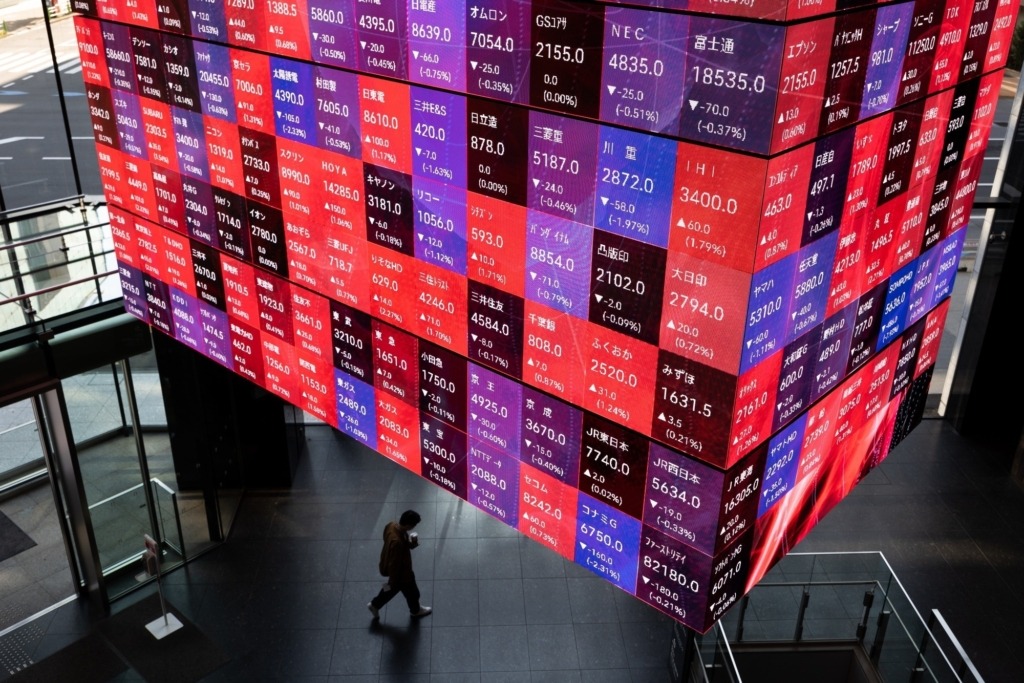
Technology stocks drove a steep decline across Asia, as investors weighed the prospect of stricter AI regulation, closer corporate oversight and whether heavy spending on AI infrastructure can be maintained. Japan’s Nikkei 225 dropped by more than 4% and South Korea’s KOSPI lost over 3%. Chinese shares also came under pressure, despite government support measures.
Wall Street gains give way to weaker futures
The sell-off in Asia followed a mixed day on Wall Street. The S&P 500 closed 0.4% higher and the Nasdaq added 0.7%, helped by a recovery in semiconductor and AI-linked stocks, with Nvidia, AMD, Broadcom and Micron all moving higher.
The subsequent decline in US futures points to renewed caution towards the technology sector. By 05:53 CET on Wednesday, US equity futures were clearly in negative territory, with the Dow Jones down 0.58%, the S&P 500 down 0.93% and the Nasdaq 100 down 1.54%. Technology remained particularly vulnerable. Even encouraging results from AMD could not offset concerns about AI valuations and the prospect of greater regulatory attention on data centre investment. The contrast between the previous session’s recovery and the subsequent weakness in futures shows how fragile sentiment towards technology stocks has become.
European markets close lower
European shares ended the previous session about 0.5% lower, although they recovered from their worst levels of the day. Investors stayed cautious ahead of the US vote and amid uncertainty over diplomacy between Washington and Tehran. Basic resources were the weakest sector, falling close to 2% as precious and industrial metal prices declined. Technology stocks lost around 0.9%, with SAP and ASML among the notable fallers. Bayer and Philips bucked the trend after positive company updates.
Commodities and currencies
Oil edges higher on supply data and Iran uncertainty
Oil prices rose in Asian trading after two sessions of losses that had been driven by hopes of a US-Iran peace deal. Brent crude gained 1% to $104.61 a barrel and WTI rose 0.8% to $96.83. Talks remain uncertain, with reports suggesting that Tehran is unhappy with Washington’s response, while recent US strikes have underlined the risk of renewed escalation. A surprise drop of 5.3 million barrels in US crude inventories also lent support to prices.
Oil remains highly sensitive to events in the Middle East. A lasting reduction in tensions could help ease inflationary pressures.
US dollar weakens as political uncertainty rises
The dollar index fell by around 0.5% to 101.34, as the early election results increased political uncertainty and reduced demand for the US currency. The euro rose 0.5% to $1.1251 and sterling advanced 0.4%. Lower Treasury yields and hopes of a diplomatic agreement between the US and Iran also weighed on the dollar.
Corporate developments and investment implications
AMD posts record data centre revenue
AMD shares jumped in after-hours trading after third-quarter results beat expectations. Adjusted earnings came in at $2.09 per share on revenue of $13.38bn. Data centre revenue almost doubled from a year earlier to a record $8.55bn, reflecting strong demand for AI chips. AMD expects fourth-quarter revenue of around $17bn, well ahead of the $16.23bn analysts had forecast. The results add to the evidence that demand for AI computing infrastructure remains strong, even as concerns grow over valuations and the returns on industry-wide capital spending.
Super Micro Computer issues upbeat revenue forecast
Super Micro Computer also reported strong numbers. Quarterly revenue rose 298% year on year to $19.9bn, while adjusted earnings of $1.81 per share were well above expectations. The company gave an upbeat full-year revenue forecast of $72bn to $82bn, pointing to continued demand for AI servers and data centre infrastructure. However, its large working capital needs and cash flow remain important factors to monitor as the business grows.
Questions over the sustainability of AI investment
Markets are paying closer attention to whether current levels of AI investment can last. Bill Ackman has warned that excessive leverage and speculative trading could add to market instability, while former Federal Reserve official Bill Dudley has pointed to the possibility that AI infrastructure investment could exceed $10trn. Investors are increasingly asking whether the vast capital spending by technology companies will deliver adequate returns, particularly as more of it is being funded through private credit, leasing and debt.
Even so, the results from AMD and Super Micro, along with Citi’s view that global memory markets will stay undersupplied in 2027, suggest that demand remains robust in certain parts of the semiconductor supply chain. For investors, this makes it more important to separate companies that benefit directly from AI infrastructure spending from those whose valuations depend on increasingly ambitious growth assumptions.
Eaton benefits from power infrastructure demand
Eaton delivered record third-quarter results. Adjusted earnings per share of $3.68 beat expectations of $3.54, and revenue grew 28% to $8.95bn. Strong organic sales growth, record orders and a growing backlog, especially in electrical equipment, pointed to lasting demand for power infrastructure. The company raised its earnings guidance and its shares rose by more than 7%. The results show that opportunities linked to data centre growth extend beyond chipmakers to the companies supplying the electrical equipment and infrastructure these facilities need.
HSBC turns more cautious on global equities
HSBC cut its global equity allocation to neutral, pointing to concerns over AI spending, geopolitical tensions and high market valuations. The bank now favours government bonds, especially US Treasuries and gilts, together with UK equities and the equal-weight S&P 500. The move reflects rising caution towards highly concentrated stock markets and a greater preference for fixed income as a source of stability in portfolios.
Booking Holdings warns of softer travel demand
Booking Holdings shares fell in after-hours trading after third-quarter revenue missed expectations and cautious guidance, although adjusted earnings came in ahead of forecasts. Revenue slipped 1% to $8.9bn, but rose 9% when a $900m regulatory charge is excluded. Gross bookings grew 10% to $54.5bn. Management flagged weaker international travel demand, linked in particular to disruption in the Middle East and higher airfares, and expects adjusted revenue growth of only 0% to 2% in the fourth quarter.
CVS Health weighs a break-up
CVS Health is exploring a separation of its retail pharmacy business from its insurance operations, a move that could unwind its $78bn purchase of Aetna in 2018. Under the plan, about 9,000 drugstores would be spun off into a separately listed company, while Aetna and the pharmacy benefit manager Caremark would stay together. The proposal comes as political pressure grows to separate pharmacy benefit managers from pharmacies and insurers, although the plans could still change.
European earnings show a selective market
Results across Europe showed wide differences in company performance. Ferrari beat expectations and raised its 2026 guidance, supported by solid demand and an order book that stretches into 2028. Philips also delivered better than expected profitability, although a large provision related to Respironics reduced net income. Lufthansa reported a stronger than expected quarterly operating profit but narrowed its full-year guidance, as higher fuel costs squeezed margins.
Alstom suffered a major setback after issuing a profit warning tied to project execution problems and cost overruns. Its planned €2bn deleveraging programme could include asset sales and an equity raising. Separately, UBS downgraded Adidas to Sell, citing slowing footwear momentum and growing pressure on margins. Taken together, these updates show why company fundamentals, pricing power and balance sheet strength matter more in a market that is becoming increasingly selective.
Geopolitical risks remain in focus
Geopolitics continues to be a major source of uncertainty for markets. Trump is reportedly considering ending the $4bn in annual US financial aid to Israel, which would mark a significant change after decades of American support. Reports also suggest that Benjamin Netanyahu has encouraged Trump to consider fresh military action against Iran after the midterm elections. While both Washington and Tehran have shown some willingness to negotiate, the risk of further escalation has not gone away. Events in the region will continue to shape oil prices, inflation expectations and central bank decisions.
What to watch today
Wednesday’s key releases are eurozone flash inflation, US ADP employment data and the ISM services PMI, which together will offer fresh insight into inflation, the labour market and the strength of economic activity. The US Treasury refunding announcement will also be closely followed. On the earnings front, Arm, Qualcomm, Uber, Novo Nordisk, McDonald’s and CVS Health are all due to report.
This information is being provided solely for information purposes and should not be deemed or construed as investment advice, tax, legal, or any other ancillary regulatory advice. CCIS does not accept liability for actions, proceedings, costs, demands, expenses, damages, and losses suffered by persons as a result of information, views, or opinions appearing in this document. The financial instruments discussed are intended for retail clients however, they may not be suitable for all investors and investors must make their own informed decisions and seek their own advice regarding the appropriateness of investing in financial instruments or implementing strategies discussed herein. The value of the investment may go down as well as up and may be affected by changes in currency. Where investments are denominated in a currency other than the investor’s base or reporting currency, changes in foreign exchange rates may adversely affect the value and/or returns of the investment. Any performance figures quoted refer to the past and past performance is not a guarantee nor a reliable guide to future performance. Calamatta Cuschieri Investment Services Ltd (C13729) is licensed by the MFSA to carry out investment services business in terms of the Investment Services Act (Cap. 370). The company is a subsidiary of Calamatta Cuschieri Moneybase plc and is registered at Level 0, Ewropa Business Centre, Dun Karm Street, Birkirkara BKR 9034, Malta.